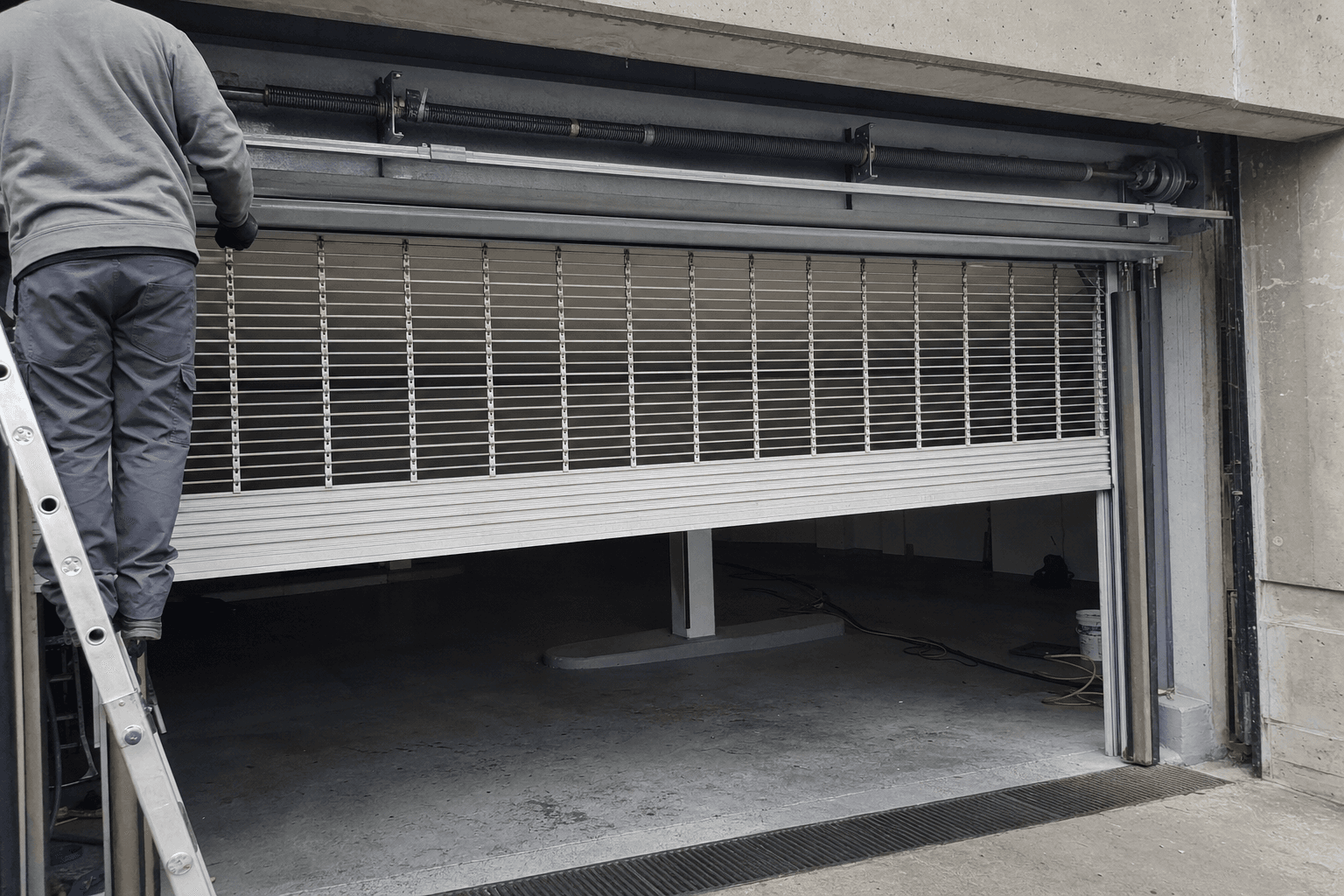
A property manager's door inspection is a short walk-around of every overhead, roll-up and parkade door on a site. Watch each door run a full cycle, listen for grinding or banging, look at springs, cables, rollers, track, seals and safety devices from a safe distance, and write down what you see. The list does not replace a service visit. It tells you which doors need one first and gives you records to show tenants and councils.
What this checklist is for
Most property managers look after more doors than they can remember. A retail strip has a roll-up shutter on every unit. An office block has a sectional door on its parkade ramp. A mixed-use building in Uptown or Downtown New Westminster may have both, plus a service door at the back for deliveries.
This list is for the walk-around you do yourself, a couple of times a year or whenever you take over a new property. It is not a repair guide. It is a way to see which doors are healthy, which are wearing, and which should be first in line for a technician.
Before you start
Pick a quiet time, early in the day before shops open or after the evening rush on a parkade. Tell tenants or residents that the doors will be opened and closed a few times. Bring a phone for photos and a short video of each door running.
Stand clear of the opening while doors move. Do not stand under a door that is partly open.
The walk-around, door by door
Watch it run
Open and close the door once from its normal control.
- Does it start smoothly, or jerk and shudder?
- Is the speed steady all the way up and down?
- Does it travel evenly, or does one side lead the other?
- Does it stop cleanly at the top and seal at the floor?
- Any grinding, squealing, popping or a loud bang?
Look at the hardware
From the floor and without touching anything, look at the parts above and beside the door.
- Springs. Gaps between coils, rust or a spring that looks stretched.
- Cables. Frayed strands, kinks or slack on one side.
- Rollers and hinges. Cracked rollers, wobble or hinges that look worn.
- Track and brackets. Dents, bends, loose bolts or brackets pulled away from the wall.
- Sections or slats. Dents, cracks, rust at the edges and paint chips.
Check the safety devices
With the door closing, wave a broom handle or a box through the photo eye beam near the floor. The door should stop and reverse. Look at the sensor lights. Look along the bottom safety edge for tears or a loose cord. If a door does not reverse, stop using it in automatic mode and book a repair.
Seals and weather strips
New Westminster is mild and wet, and the steep slopes down to the Fraser leave many sites in shade for much of the day. Doors that rarely dry out wear their seals faster. Look for split, flattened or missing bottom seals and side strips, and for water stains on the floor inside.
Controls and access
Try the wall button, a remote and any key switch. Note a control that has to be pressed more than once, or a remote that only works up close.
Older buildings need a closer look
New Westminster has some of the oldest building stock in the region. Converted buildings in Sapperton, Brow of the Hill and the downtown core can have doors that were added or changed over the years, sometimes with mismatched parts. Steep sites and tight lanes can also make door work harder to stage. On those sites, note the door's rough age, the operator brand and anything that looks like an old repair.
Newer sites in Queensborough sit low beside the river on flat land. There, look closely at the bottom seal and at any rust starting on track and fasteners near the floor.
Writing it down
Keep one page per door. A simple layout works.
- Building, door location and door type.
- Date of the walk-around and who did it.
- What you saw and heard, with photos.
- Whether it passed the reversal test.
- What needs attention, marked now, soon or watch.
After a few rounds these pages become a history of each door. That helps when a tenant, a council or an insurer asks for maintenance records, and when you are deciding whether an older door is worth more repairs.
What to leave to a technician
Never adjust springs, cables, drums or the operator's settings yourself. Springs hold a large amount of stored energy. If you hear a bang, see a loose cable or the door hangs crooked, keep people and vehicles out from under it and call for repair.
When to book a service visit
Book a visit for any door marked now, any door that failed the reversal test, and any door with no service record at all. A service visit covers lubrication, spring and cable checks, balance and safety tests, and small repairs, and most doors take under an hour. Several buildings can share one schedule, so your notes and ours line up door by door.