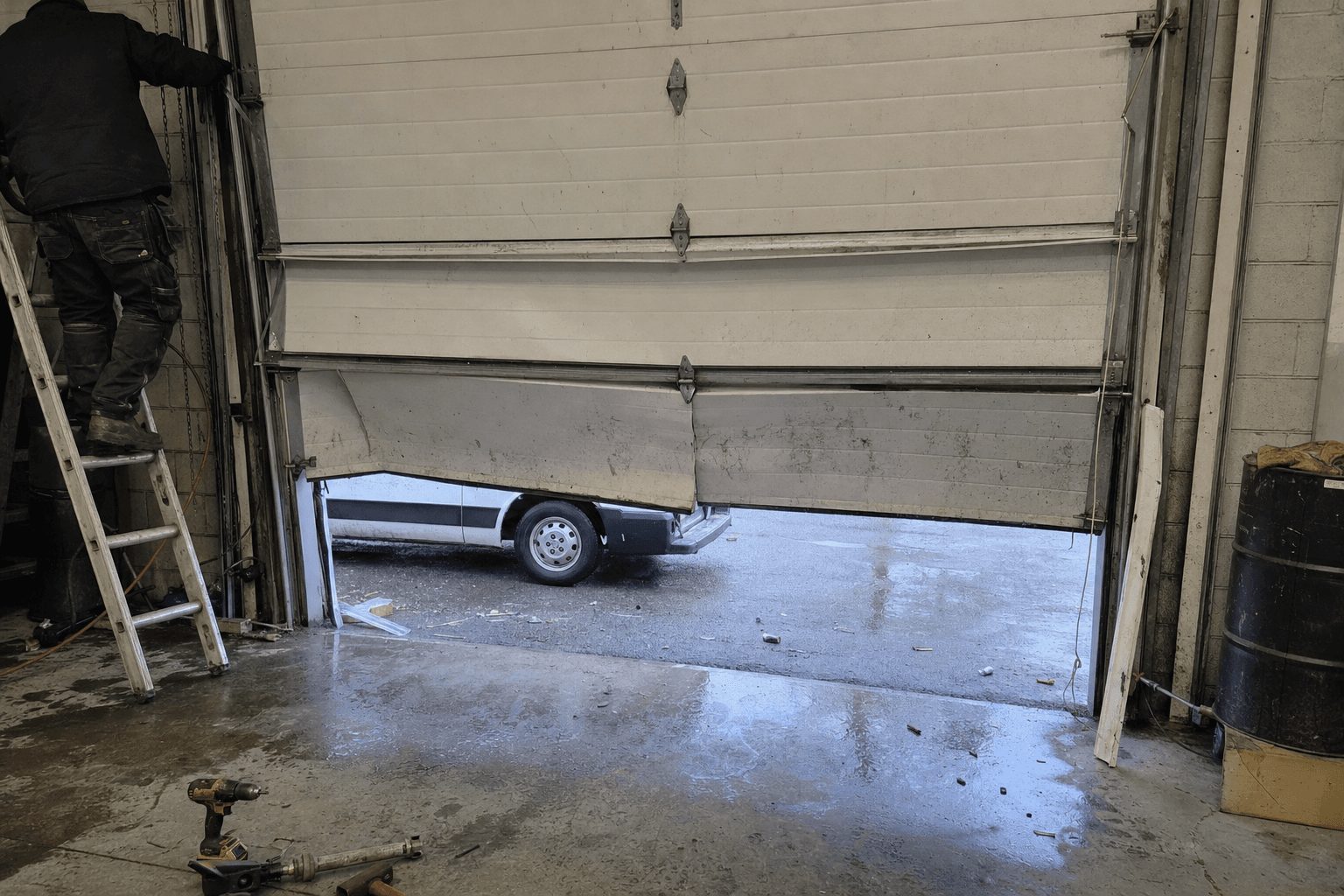
Auto service bay doors fail in two ways: slow wear from opening and closing all day, and sudden damage when a car or van clips the door, track or bottom section. Cut impacts with clear sightlines, a door that opens fully and staff who wait for it. After a hit, stop using the door and keep people clear. Bent sections, track and brackets can often be replaced without a new door, and the work can be booked early or late.
The two ways bay doors wear out
An auto service bay door works harder than most doors in a retail plaza. It opens for every car that comes in and every car that leaves, often with the shop busy and staff moving quickly. That creates two kinds of trouble.
- Slow wear. Springs, rollers, hinges and cables wear with every cycle. Rollers and hinges start to grind, and springs reach the end of their life sooner on a busy bay.
- Sudden damage. A car or van clips the bottom section, the track or a jamb as it rolls in or out. The door may still run, but now it is out of line.
In Langley, shops in Willowbrook, along the commercial strips near Langley City Centre and in newer plazas in Willoughby see both.
How impacts usually happen
- A vehicle starts moving before the door has finished opening.
- A tall van or one with a roof rack catches the bottom of a door that stops short of fully open.
- A car is reversed out at an angle and clips the track or the jamb.
- The door starts closing while a vehicle is still under it.
Cutting down the hits
- Make sure the door opens all the way and stays there. A door that stops a little short is asking to be hit.
- Keep the opening clear of tire racks, carts and signs so drivers can see it.
- Ask staff to wait until the door has stopped before moving a vehicle.
- Mark the opening and the jambs so they are easy to see.
- Keep the photo eyes clean and in line so the door reverses if something is under it.
What to do after a hit
- Stop using the door. Do not press the button again to see if it still runs.
- Keep staff, customers and vehicles out from under it.
- If it is stuck part way, leave it there. Do not pull it down or prop it up.
- Take photos of the bottom section, the track on both sides and any brackets.
- Call for repair and say whether the bay needs to be secure overnight.
A door knocked off its track can drop or twist. A bent track can also put load on the spring and cables, which is why a quick look is not enough.
What to have ready
The door size, its rough age, whether it is sectional or roll-up, the operator brand and photos of the damage help us bring the right parts.
What a repair involves
Most hit doors can be put right without a new door. Bent sections, track and brackets can often be replaced on their own, and rollers and hinges damaged in the impact are changed at the same time. If several sections or the track are badly damaged, a new door can cost less than the repair.
Spring, cable and roller repairs usually take a few hours. Replacing sections or track takes longer. The work can often be scheduled early or late so the bay is out of use for as little time as possible.
Keeping the daily wear in check
High-cycle springs
Doors that open many times a day wear springs faster. High-cycle springs are built for that and last longer on busy bays.
Regular service
A service visit lubricates moving parts, checks springs, cables, rollers and hinges, and tests balance and safety reversal. Most doors take under an hour.
Seals and weather
Langley is further inland than the coastal cities, with colder winter nights and more frost and snow. Bottom seals can freeze to the slab, and springs are stressed on cold mornings. Murrayville, Aldergrove and Fort Langley sites see the same pattern. A torn weather seal also lets rain and wind into the bay where staff are working.
When to call
Call after any impact, even if the door still runs, and whenever rollers grind, the door drops fast or will not stay up. A bay door that keeps working after a hit is often wearing itself out of line.