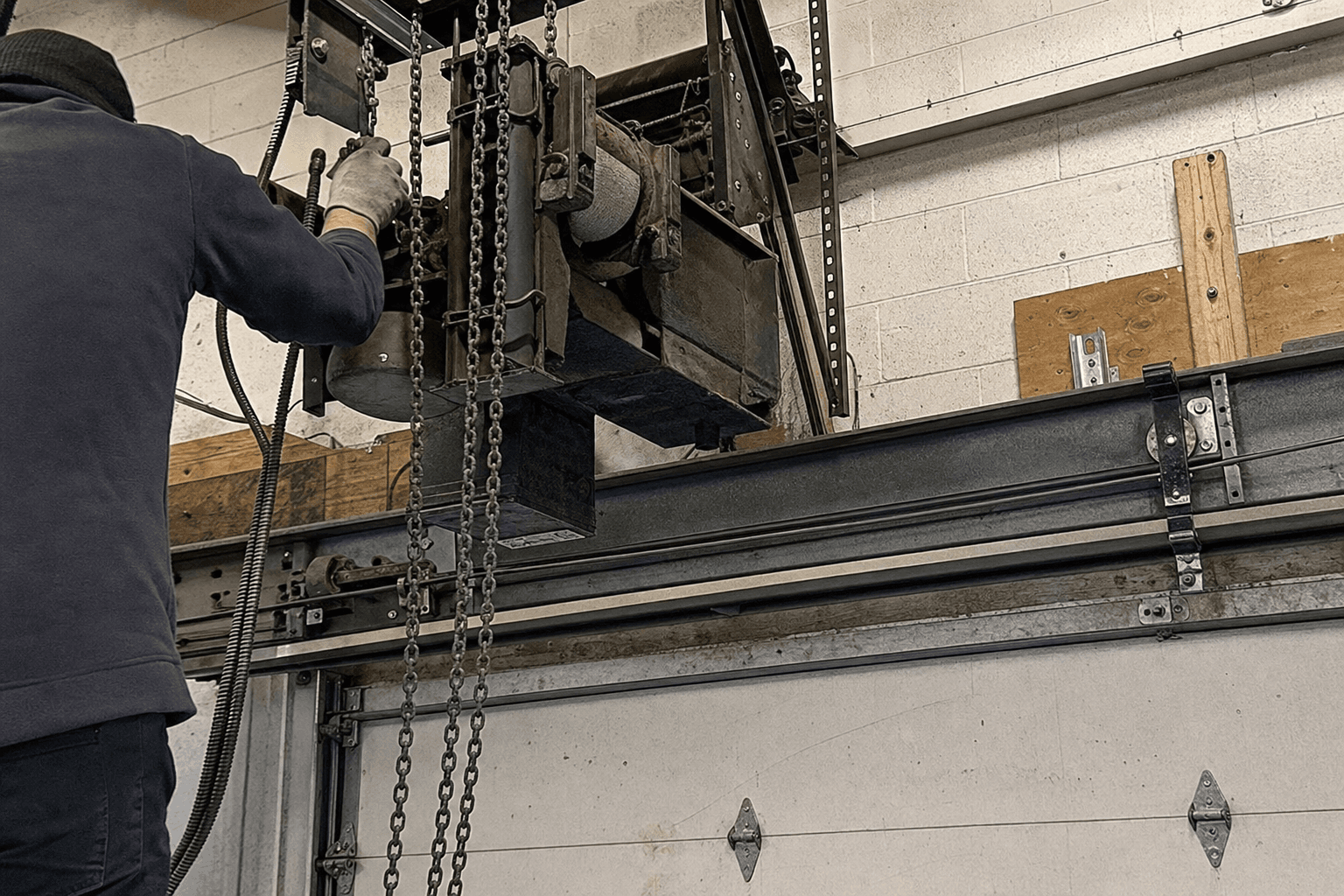
A commercial operator that hums but won't move the door usually has power but cannot turn the load. The usual causes are a door frozen to the floor, a broken spring, a jam or off-track door, a released trolley, or worn drive parts. Check the door first and stop pressing the button. Repeated tries can burn out the motor.
What the hum tells you
When an operator hums and the door stays where it is, the motor is getting power. It is trying to work. Something is stopping it from turning the door.
That is useful. It means the wall control, wiring and power supply are probably fine. The problem sits in the door, the springs, or the drive between the motor and the door.
This applies to the operators we deal with on commercial properties. That includes trolley, jackshaft and hoist operators on storefronts, offices, auto service bays and strata parkades in Maple Ridge.
Check the door before you blame the operator
Most humming calls turn out to be a door problem. Look at these first, from a safe distance.
- Frozen to the floor. The bottom seal can freeze to the slab after snow or ice. The operator pulls, the seal holds, and you hear a hum.
- Broken spring. A door with a broken spring is far heavier than the operator is built to lift. Look for a visible gap in the spring, or a door that feels very heavy by hand.
- Jam or off-track door. A bent track, a slipped roller or something wedged in the guides will stop the door.
- Released operator. Trolley operators have a release cord. If someone pulled it to open the door by hand, the door may not be engaged with the drive.
- Blocked safety devices. Some doors will not run if a photo eye is blocked or a safety edge is triggered. That usually gives a reversal or no movement rather than a hum, but it is worth a quick look.
Why November matters in Maple Ridge
Maple Ridge gets more rain than the western suburbs and colder winters. Outflow winds down the Fraser Valley bring hard frost and sometimes snow. That stiffens doors and stresses springs.
A door that ran fine in October can feel very different after the first hard frost. Stiff rollers, a stuck seal and a tired spring all add load. The operator takes the strain, and cold makes operators less willing to start.
The shaded, damp side of town stays wet longer. Properties near Golden Ears and the forested north side hold moisture around door bottoms and tracks. That makes freezing to the floor more likely there.
The building type changes the likely cause. Older storefronts and shops around Haney and Hammond often have older doors and older operators. Newer strata buildings in Silver Valley and Albion tend to have parkade doors with more recent equipment. Rural business properties toward Whonnock and Thornhill, with detached shops, often have long gaps between inspections.
What not to do
A few habits make a small fault into a larger one.
- Do not keep pressing the button. Each try heats the motor. Overheating on a busy door is a problem on its own.
- Do not pull the door loose with a vehicle or by force. You can bend the door, the track or the operator mount.
- Do not adjust or release the springs or cables. They hold a lot of stored force and can injure someone.
- Do not chip ice from the seal with a sharp tool. You can cut the seal and let in more water.
- Do not bypass photo eyes or safety edges to get the door moving.
If the door is frozen and the spring and tracks look fine, clearing loose ice and snow from the floor edge with a plastic scraper is reasonable. Then try the door once. If it hums again, stop.
Causes inside the operator
If the door is free, light and on its track, the fault may be in the operator itself. Common causes include:
- Worn drive parts, such as a chain, belt, gear or coupling that no longer grips.
- A motor that has lost its ability to start under load.
- A motor that has overheated from being undersized for the number of cycles.
- Slipping on a jackshaft or hoist drive.
A technician has to test these. The symptoms overlap, and guessing leads to replacing parts that were fine.
Repair or replace
Most operator repairs take a few hours. Installing a new operator takes about a day.
Repair makes sense when the operator is sized properly for the door and parts are available. It is a poor choice when the same fault keeps coming back or when the unit is old and parts can no longer be found. That happens with older equipment in some Haney and Hammond buildings.
Sizing matters. A properly sized operator with working safety devices keeps a busy door reliable. An undersized unit on a door that cycles all day will overheat and wear out early. If your humming operator also runs hot, mention that when you call.
Keeping the building working meanwhile
For a storefront or office, the main concern is security. If the door is stuck open, you need it closed and secured overnight. If it is stuck closed, you need access for staff and deliveries.
For a strata parkade, such as in a Silver Valley townhouse complex, a stuck door affects every resident. The strata sets the door rules, so council should know who to contact and what residents should do. Posting a short notice about the fault and the expected repair time reduces calls.
We plan work around opening hours, tenants and residents. The aim is to keep the door out of use for as little time as possible.
When to call a professional
Call a professional if the door is free of ice and still will not move, if you can see a broken spring or damaged cable, or if the operator has hummed and then gone quiet. Call as well if the motor feels hot, or if the door has done this more than once. Any job that involves springs, cables or opening the operator housing is not one to do yourself. If you only need to know whether a frozen seal is the cause, the checks above will tell you.