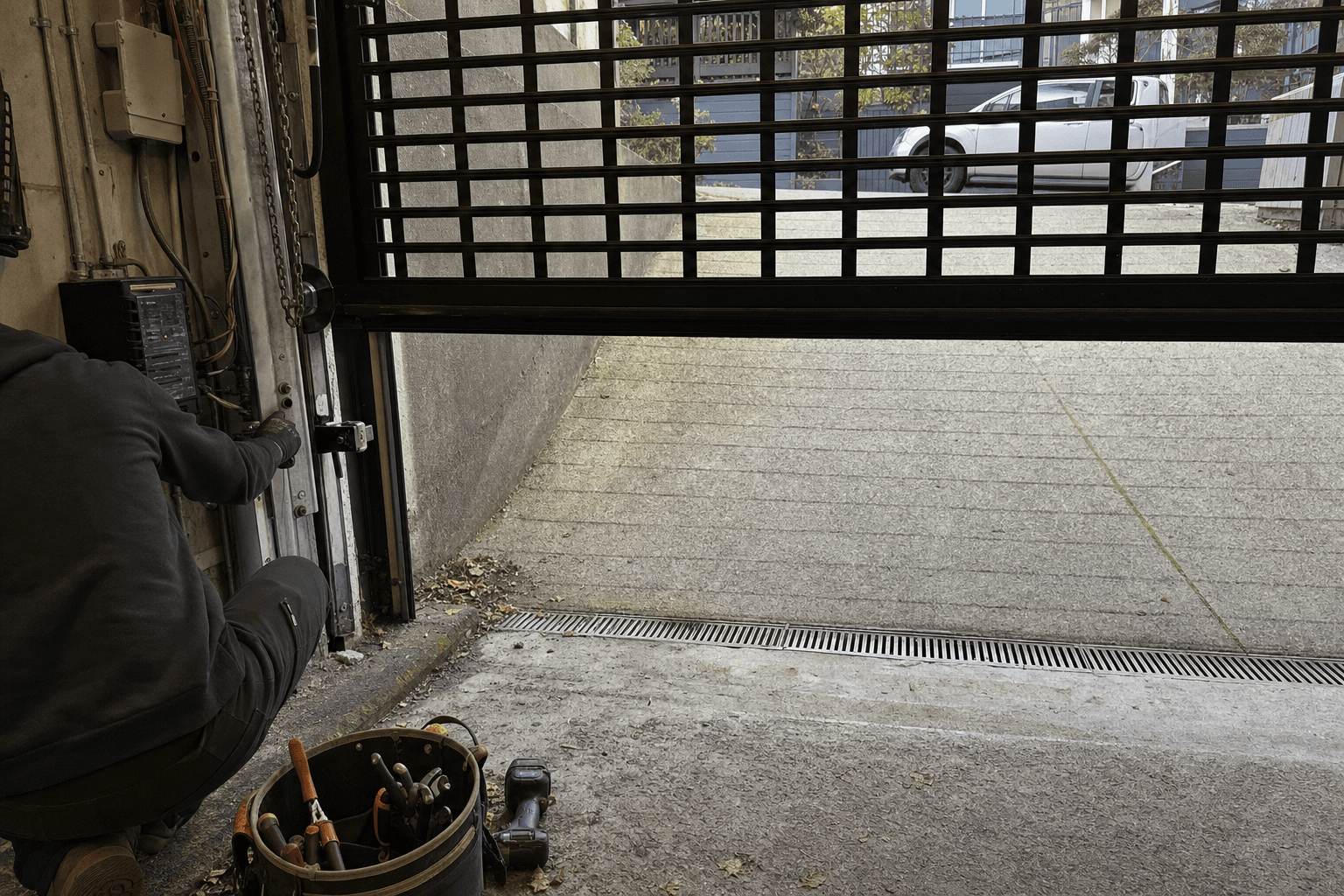
A parkade door that closes on cars or fails to detect them usually has dirty or misaligned photo eyes, a worn or damaged safety edge, or operator settings that have drifted. Wet, tree-covered North Vancouver garages make all three more likely. You can wipe lenses and look for damage safely. Most sensor and safety-edge repairs take a few hours, but a door that hits vehicles should be taken out of normal use.
The short answer
When a parkade door closes on a car, or doesn't notice one in the way, the cause is usually one of three things. The photo eyes are dirty or out of line. The safety edge on the bottom of the door is worn, cut or damaged. Or the operator's settings have drifted. Most of the time you can see the first two from the ground.
This matters more than a nuisance repair. A door that doesn't detect vehicles can damage cars and injure people. It also becomes a liability for the strata or owner.
What stops a parkade door from closing on a car
Two systems do the work, and the operator ties them together.
Photo eyes
Photo eyes are a pair of small sensors, one on each side of the opening, mounted low. One sends an invisible beam to the other. If a bumper, a person or a bike breaks the beam while the door is closing, the door should stop and reverse.
Safety edge
The safety edge is the soft strip along the bottom of the door. If it touches something, it signals the operator to stop and reverse. It is the backup when the photo eyes miss something, such as a low object or a vehicle that stopped at an angle.
Operator settings
The operator is the motor and control unit. It has travel limits and force settings. If these are off, a door can push too hard before it reverses, or it can fail to reverse at all.
Common causes in North Vancouver
North Vancouver is one of the wettest parts of the region. Rain increases sharply toward the mountains, and heavy tree cover keeps many properties damp. That shows up in parkade doors in a few ways.
- Dirty lenses. Road spray, moisture and debris from tall cedar and fir collect on photo eye lenses. In Lynn Valley, Edgemont and Seymour, where trees crowd many buildings, this happens often.
- Misaligned sensors. A bumped bracket or a nudge from a vehicle can knock a photo eye out of line. The beam no longer reaches the other side, or it reaches it only some of the time.
- Damp in the wiring or the edge. Constant wet can get into connections and into the safety edge. The result can be a door that reverses for no reason, or one that doesn't reverse when it should.
- Worn or damaged safety edge. Years of heavy use, vehicle contact and cold stiffening can split or flatten the edge.
- Sloped entries. Some parkades sit on steep ground, especially on the upper slopes. If the floor at the door slopes, the door may not meet it evenly, and the sensors and travel limits can behave oddly.
- Frost and snow. In upper neighbourhoods like Lynn Valley and Blueridge, frost stiffens a door and can change how the operator reads its travel.
Condo buildings around Lower Lonsdale and older walk-ups often have parkade doors that have seen years of daily cycles. Wear builds up slowly, so the first sign is often one near miss.
What you can check safely
A property manager or council member can do a quick visual check. Keep people and vehicles clear of the door while you do it.
- Look at both photo eyes. Check for dirt, spider webs, cracked housings and loose brackets.
- Wipe each lens with a soft, clean cloth.
- Check that both sensors point at each other and sit at the same height.
- Look at the safety edge along the bottom of the door. Note any splits, flat spots, or places where it has pulled away.
- Look for exposed or pinched wires near the sensors and along the edge.
- Watch the door run with the area clear. Note whether it stops, reverses, or slams to the floor.
Write down what you see and when it happens. Notes such as "only in heavy rain" or "only the third door cycle of the morning" help a technician find the fault faster.
What not to do
Do not hold the button down to force the door to close. Do not tape over a sensor or disconnect it to stop nuisance reversing. That removes the protection that keeps people and cars safe.
Do not change the operator's force or travel settings unless you are trained to. Wrong settings can make a door hit harder, and they can hide a deeper problem.
If the door has already closed on a vehicle, take it out of normal use if you can. Post a notice and arrange a repair.
What a repair usually involves
A technician tests the photo eyes and the safety edge, checks the wiring, and confirms the operator reverses when it should. Typical fixes include cleaning and re-aligning sensors, replacing a photo eye, replacing a worn safety edge, and resetting travel limits and force.
Most operator, sensor and safety-edge repairs take a few hours. If a part has to be ordered, the job takes longer. We plan the work with the strata or property manager so residents can still get in and out. That might mean working in stages or setting up a temporary way to control access.
When to call a professional
Call a technician if the door has closed on a vehicle, if cleaning the lenses doesn't fix the problem, or if the safety edge is damaged. Call too if the door reverses at random, or if you see wiring damage. A door that fails to detect vehicles is a safety issue, and it is worth fixing before the next close call.