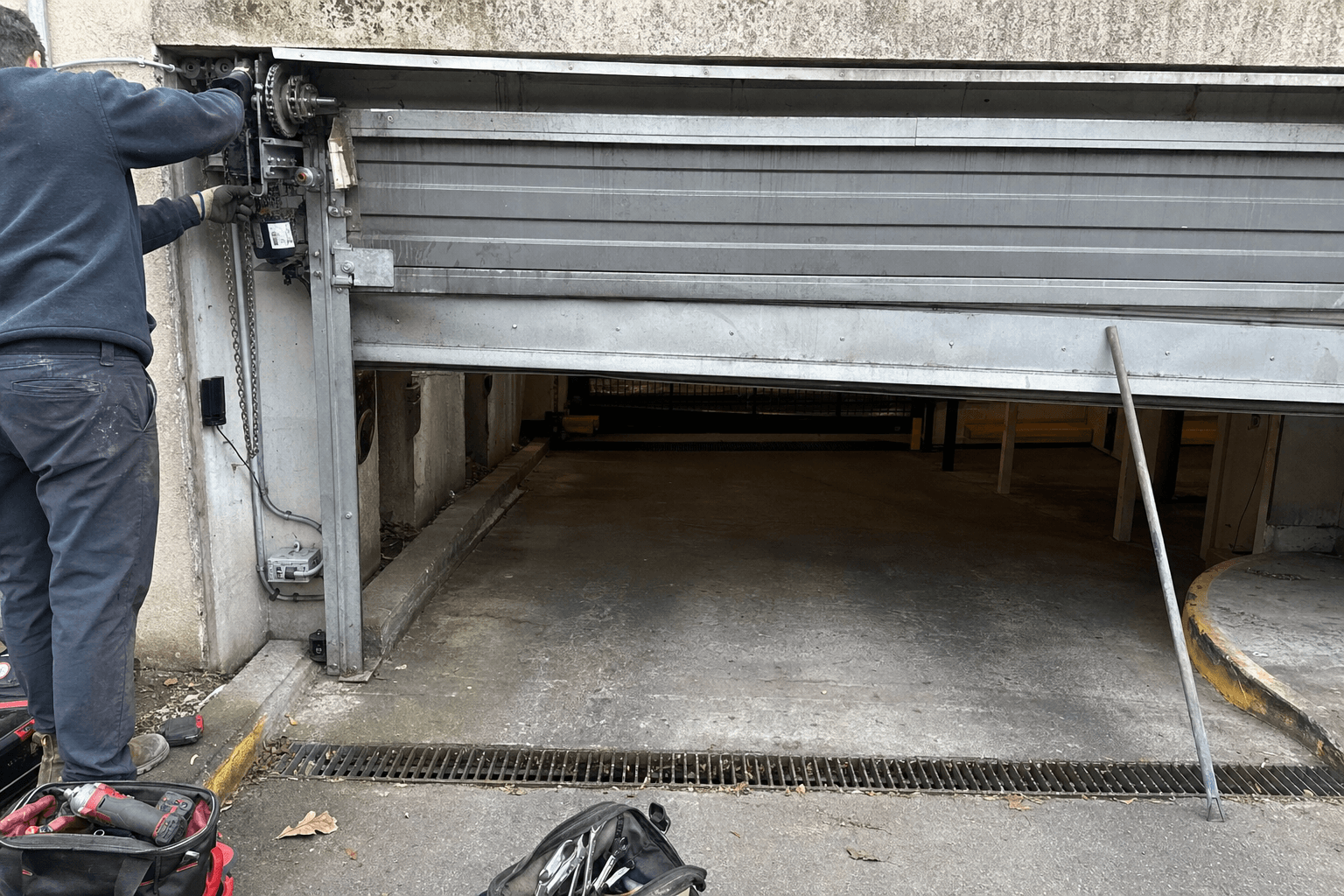
A slow, noisy parkade door is usually caused by worn rollers, hinges, springs, cables or a tired operator, and most of it can be repaired without replacing the door. In Delta, salt air near Tsawwassen, Beach Grove and Boundary Bay speeds up rust. Most repairs take a few hours, longer if parts must be ordered.
Short answer
A parkade door that has gone slow and loud is telling you something is wearing out. Most of the time it is the rollers, hinges, springs, cables or the operator. It is rarely the whole door. A repair is usually possible, and catching it early keeps a noisy door from turning into a stuck-open door.
Why parkade doors wear so fast
A house garage door might cycle a few times a day. A parkade door at a townhouse or apartment complex can cycle many more times than that, every day, for years. Every resident, visitor and delivery driver uses it.
That heavy use wears moving parts faster than most people expect. The door starts to sound different first. Then it slows down. Then it starts to stop part way or reverse.
Common causes of a slow, noisy door
These are the usual suspects, roughly in the order we find them.
- Worn or dry rollers and hinges that grind or squeal as the door travels.
- Tracks that have shifted or have loose fasteners, so the door rubs instead of rolling.
- Springs or cables that are tired or stretched, so the door is out of balance and the operator has to do the lifting.
- A worn operator, with a slack chain or belt, worn gears, or travel limits that have drifted.
- Rust on hardware, springs and cables.
- Photo eyes or safety edges that are dirty, knocked out of line or failing, which can make a door hesitate or reverse.
A door that is out of balance is the one to watch. The operator is built to move a balanced door, not to carry a heavy one. Run it that way for long and the operator is the next thing to fail.
What Delta adds to the problem
Strata share in Delta is lower than in most Metro cities, so parkades are fewer. You find them mostly in townhouse and apartment buildings in Ladner, Tsawwassen and North Delta. The ones that exist tend to be busy, and they are exposed in different ways.
Near the water, salt air does steady damage. In Tsawwassen, Beach Grove and Boundary Bay, salt rusts springs, cables and hardware. Rusted parts bind, and a door with binding parts gets louder and slower before anything breaks.
Ladner and Tsawwassen are open to wind off the water. Wind drives rain under worn bottom seals. In November, with the wet season under way, that is when a worn seal starts to show. Water and salt together speed up rust at the bottom of the door and the track.
Cold snaps also bring spring breaks. A spring that is rusted and worn is the one most likely to let go.
What you can check without touching the hardware
A council member or property manager can do a quick check from the ground. It is useful to have notes when you call.
- Watch a full open and close. Note where the door slows or hesitates.
- Listen for where the noise comes from. Grinding at the sides points to rollers or tracks. A groan from the motor points to the operator or an out-of-balance door.
- Look at the bottom seal for gaps, cracks or flattened rubber.
- Look for orange rust on springs, cables, hinges and track.
- Check that photo eyes are clean, facing each other and not knocked loose.
- Note whether remotes and fobs still work at the usual distance.
Do not touch the springs, cable drums or brackets. They are under high tension and can injure someone badly. Leave them to a technician.
Repair or replace
In most cases the door itself is fine. Rollers, hinges, cables, springs, photo eyes, safety edges and operator parts can be replaced one at a time. That keeps cost down and keeps the door in service.
Replacement starts to make sense when sections are damaged, for example after a vehicle strike, or when rust has spread across the door and track so widely that repairs would not hold. A technician can tell you which case you are in after looking at the door.
Most operator, sensor and safety-edge repairs take a few hours. If a part has to be ordered, the job takes longer. It helps to know that early so the strata can plan.
Keeping residents moving during the work
A parkade door is the way in and out for everyone in the building. Work should be planned with the strata or property manager so residents can still get through. That might mean doing the work at a quiet time of day, giving notice in advance, or staging the repair so the door is out of use for as little time as possible.
When to call a professional
Call when the door has changed in sound or speed and cleaning the photo eyes does not fix it. Call sooner if you see rust on springs or cables, a frayed cable, a door that sits crooked, or a door that reverses or stops part way. A door that is stuck open also leaves the building unsecured, so it should not wait. A short visit can tell you whether it is a small repair or something to budget for, and you can decide from there.