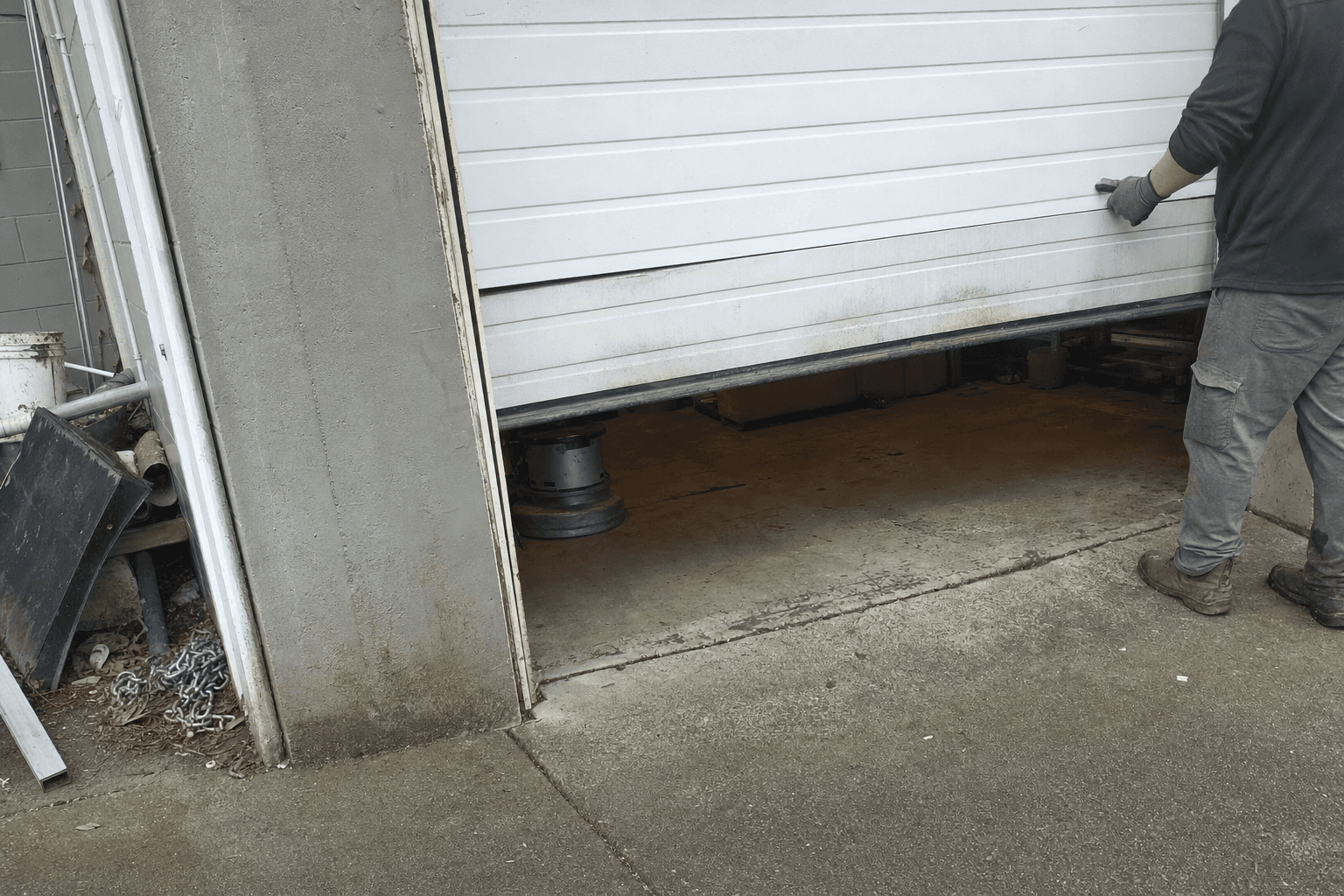
Rain under a commercial overhead door usually comes from a worn or flattened bottom seal, a bent bottom section that no longer sits flat, or water running toward the threshold. Close the door, look for daylight along the bottom edge, and check the floor slope. A seal is a simple fix. A bent section or track needs a repair.
The short answer
When rain gets in under a commercial overhead door, the cause is almost always at the bottom edge. The seal is torn or flattened, the bottom section is bent, or the door is not closing fully. Sometimes the door is fine and the water is simply running toward it.
With Halloween four days away, the wet season in Burnaby is here. Heavy rain is when gaps in the bottom seal show up. It is a good week to check.
Where the water usually gets in
These are the most common causes on shops, retail units, auto service bays and strata parkades.
- A torn, cracked or flattened bottom seal. The rubber loses its shape and no longer fills the gap against the floor.
- A bent bottom section. If a van or car has clipped the door, the bottom section may be bowed. The seal cannot sit flat against the floor, and the section often scrapes as well.
- Worn side and top weather stripping. Wind-driven rain comes in at the edges, not only at the floor.
- A door that stops short. Track that has been knocked out of line, or a worn roller, can leave the door a little off the floor when it closes.
- A sloped or pitted threshold. If the concrete dips or drains toward the door, even a good seal will be overwhelmed.
Checks you can do yourself
You do not need tools for these.
- Close the door fully. From inside, in daylight, look along the bottom edge and both sides. Any light you can see is a gap water can use.
- Run your hand along the bottom seal. Look for tears, hard or brittle sections, and places where it has flattened or come out of its channel.
- Look at the bottom section itself. Check for a bow, a dent or a crease, especially at the corners.
- Watch the door close. If it scrapes, stops unevenly or looks crooked, the problem is bigger than the seal.
- Check the floor. Note where water pools outside and which way the slope runs.
- Look for a wet line on the floor after the next rain. It shows you exactly where the gap is.
Why Burnaby sites see this more
Rainfall rises with elevation. Capitol Hill and Burnaby Mountain stay wetter and cooler than the south slope near the Fraser. A door up there takes more water over the season.
Ravine parks and greenbelts also leave many lots shaded for much of the day. A shaded threshold stays damp longer, so water sits against the seal instead of drying off.
Steep driveways in Capitol Hill and the Heights put extra wear on bottom seals and can let water in. The same applies to ramped entries at retail units and parkades around Metrotown, Brentwood and Lougheed. Water follows the slope and arrives at the door.
Fixes that don't need a door technician
Some causes are not the door.
- Clear leaves, grit and debris from the threshold and any drain grate in front of the door.
- Sweep out standing water so the seal is not sitting in it.
- Ask your site or paving contractor about the slope if water consistently pools against the door.
These are worth doing even if you also replace the seal.
What the repair involves
If the seal is the only problem, it is replaced along the bottom edge and the door is tested. Side and top weather stripping can be replaced the same way.
If the bottom section is bent, a new seal will not hold. The section may need straightening or replacing, and the track and rollers should be checked at the same time. A door that was hit usually has more than one problem.
Most spring, cable and roller repairs take a few hours. Replacing sections or track takes longer. For strata buildings, any replacement parts should match the existing door style and colour so they stay within council rules.
On a retail unit or service bay, the work can be planned around opening hours and tenants so the door is out of use for as little time as possible.
What to avoid
Do not tape or caulk over a gap at the bottom of a working door. It can bind the door or keep the opener from reading the floor correctly. Do not keep running a door that scrapes or closes crooked. That wears the opener, rollers and track, and a small repair becomes a larger one.
When to call a professional
Call if you can see daylight at the bottom of a closed door and the seal looks fine, if the bottom section is bent, or if the door scrapes, sticks or closes unevenly. Those point to a section, track or roller problem. A torn seal on its own is a smaller job, but it is still worth having someone look at the whole door while they are there. If you manage several doors across Burnaby, a short visit before the heavy rain settles in can show you which ones need attention first.