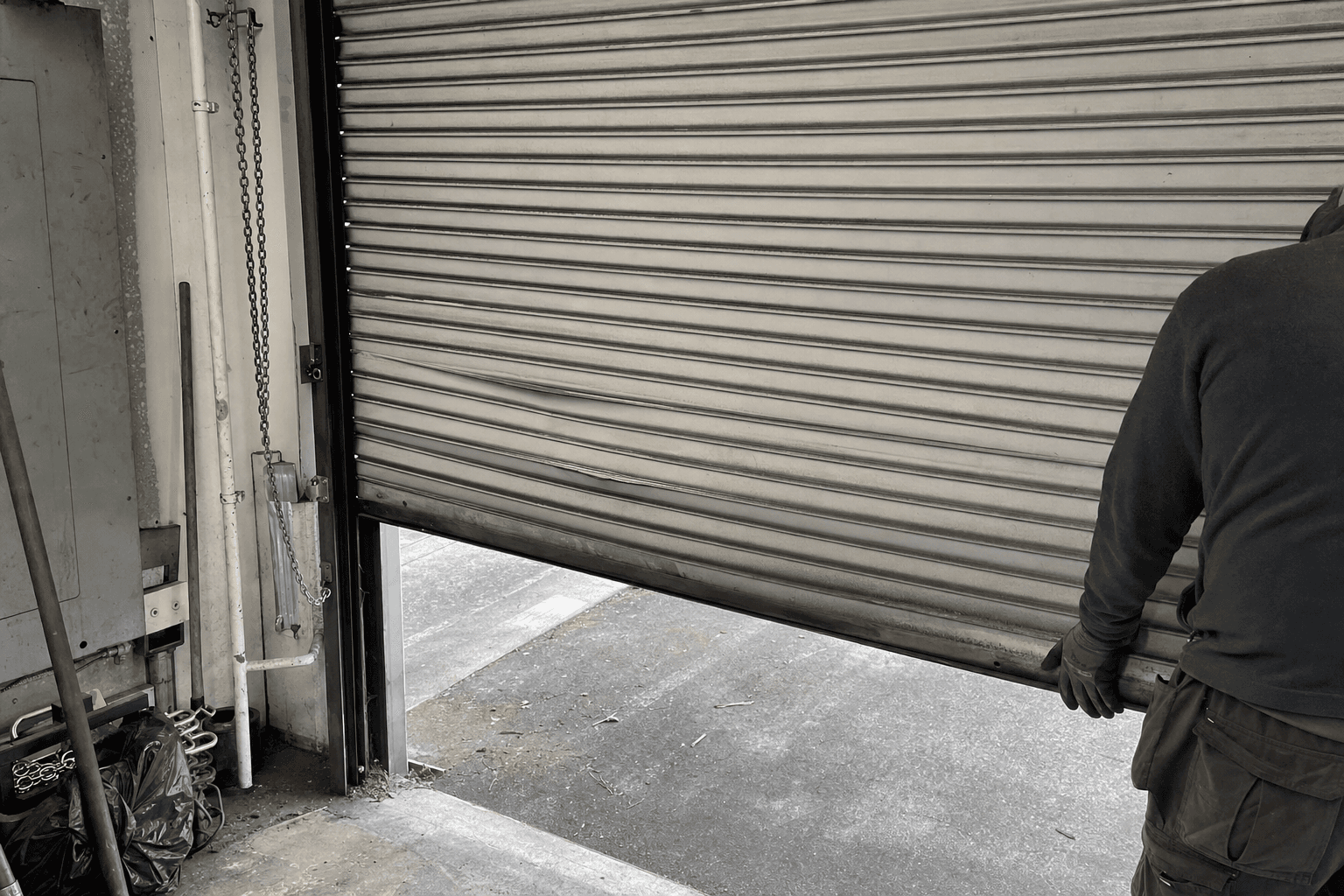
Yes, in many cases. One or a few dented slats, a bent bottom bar or a bent guide can usually be repaired without replacing the curtain. A new curtain makes sense when damage spreads across many slats, the interlocks have separated, rust has weakened the steel, or the curtain no longer coils evenly. A technician needs to see it move to decide.
Short answer
Often, yes. One slat or a few can usually be straightened or swapped, and the rest of the curtain stays. The curtain needs replacing when the damage is widespread or the steel is no longer sound. Which one you have depends on where the dents are and how the door moves.
This applies to rolling steel doors and roll-up shutters on storefronts, storage units and service counters. It does not cover house garages or warehouse and loading dock doors.
Why a dent matters more near the slat ends
A rolling steel door is a curtain of interlocking slats. Each slat hooks into the next. The ends of the slats ride in the guides on both sides. The whole curtain winds around a barrel at the top.
A shallow dent in the middle of a slat is mostly cosmetic. A dent or bend at the end of a slat is a different problem. The end has to slide freely in the guide. If it is bent, the door drags, catches or jams in its guides.
That extra drag shows up elsewhere. The door gets hard to lift. It may not stay up. On a motorized door, the motor can hum while the curtain does not move. A bent slat is often the starting point for those symptoms.
Damage that can usually be repaired
These problems are often fixed in a single visit.
- One slat or a few with shallow dents and no sharp creases
- Slat ends bent at the guide, where the steel is not torn
- A bent bottom bar
- A worn or torn weather strip on the bottom bar
- Guides knocked slightly out of line by an impact
- Spring tension that has drifted and needs adjusting
A damaged slat can be replaced individually if a matching profile is available. That is usually cheaper and quicker than a new curtain.
Damage that usually points to a new curtain
Some damage is not worth patching.
- Many slats dented or creased across the width of the door
- Slats that have separated at the interlocks
- Rust that has gone through the steel, not just surface rust on the guides
- A curtain that no longer coils evenly and rubs or drifts on the barrel
- Old slats where a matching profile cannot be sourced
Patching a curtain in this condition tends to bring the same jam back in a few weeks. A new curtain costs more up front but ends the repeat visits.
What to check before you call
A few minutes of notes and photos save time on the visit.
- Note where the damage is and how many slats are affected.
- Take photos of the slats, the guides and the bottom bar, from the inside and outside if you can.
- Note whether the door moves by hand, binds at one spot, or will not move.
- Check whether the lock still lines up and works.
- Note any rust at the guides and the bottom of the slats.
Do not force a stuck door. Do not hammer on slats while the curtain is under spring tension. A door that jams under force can bend more slats or damage the motor. Spring tension can also injure someone. If the door will not move, leave it where it is and keep people clear.
Langley conditions that make damage worse
Langley sits further inland than the coastal cities. Winter nights are colder, and there is more frost and snow. Steel stiffens in the cold, and a bottom bar can freeze to the floor. Forcing a frozen door up is a common way slats get bent. Let the seal thaw or free it gently before you run the door.
Moisture is the other factor. Where water sits at the bottom of a guide, rust follows. Rust at the guide edges drags on the slat ends and speeds up wear. Storage units in Aldergrove and storefronts in Murrayville that get little attention in winter are the ones we would check first for this.
Impacts are the most common cause of dents. Delivery vans, carts and the odd reversing vehicle hit shutters in plazas around Langley City Centre and Willowbrook. With Halloween two days away, evening foot traffic around retail frontages is higher. If a shutter is damaged and will not lock, say so when you call so the visit can be planned around your closing time.
How long the work takes
Most adjustments and slat repairs take a few hours. A new curtain takes longer. We plan the work around opening hours, tenants and residents, so the door is out of use for as little time as possible. For a storefront, that often means working before opening or after close.
When to call a professional
Call when a door jams in its guides, will not stay up, will not lock, or has dents that reach the slat ends. Call too if the motor hums and the curtain stays still. If you are unsure whether the damage is cosmetic, send photos. A technician can usually tell you whether it looks like a repair or a new curtain, and a visit will confirm it.