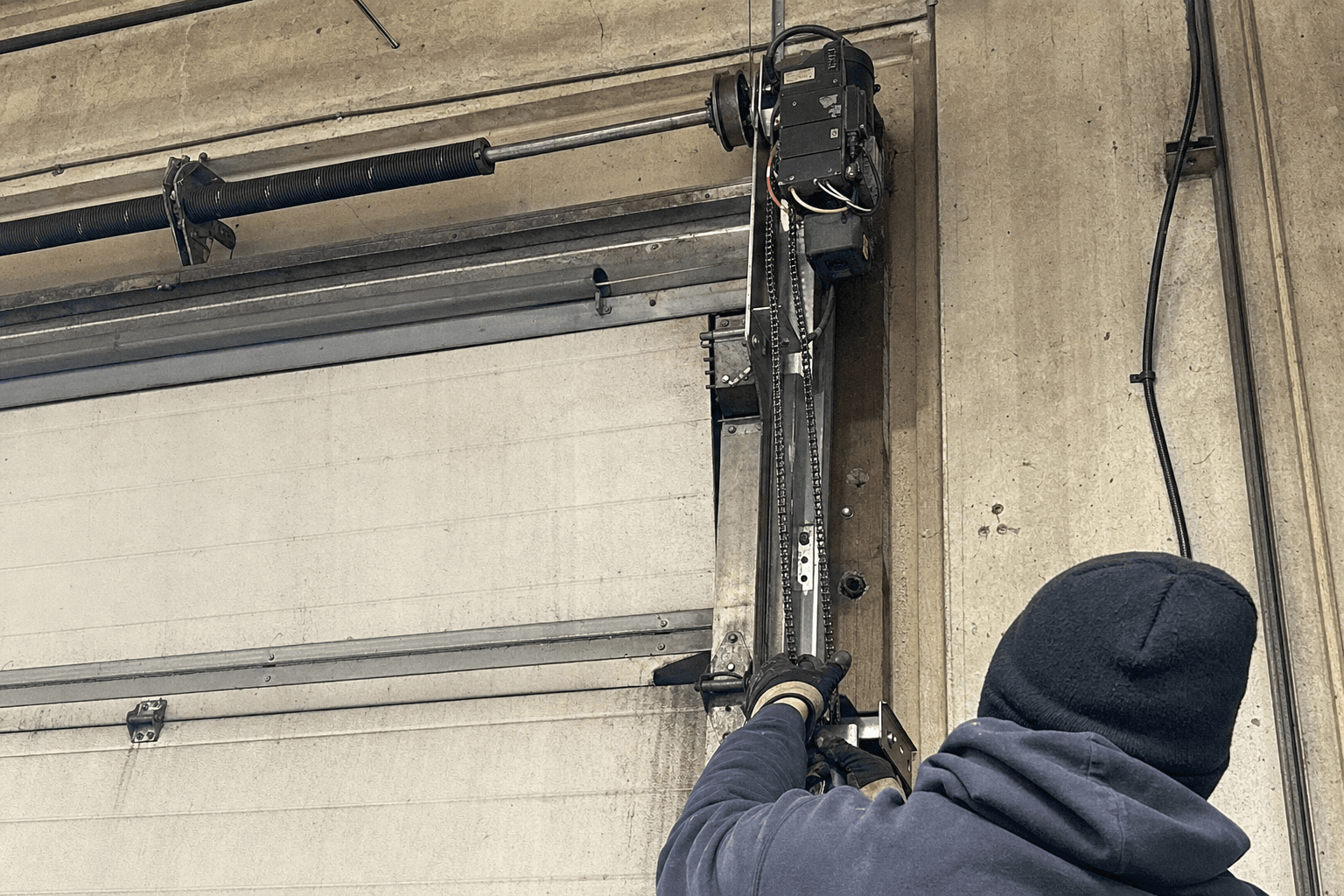
Replace a commercial door operator when parts are no longer available, when it overheats or fails on a busy door even after the door is balanced, or when safety devices can't be made to work reliably. Repair makes sense when the fault is a wall control, photo eye, safety edge or a single worn part. Most repairs take a few hours. A new operator takes about a day.
The short answer
If a commercial door operator is old and nobody can supply parts for it, replace it. If the fault is a wall control, a photo eye, a safety edge or one worn part, repair it.
That is the rule we use at the counter. The rest of this article explains how to tell which case you have, so you can decide before anyone arrives.
Signs an operator is past repair
These are the usual signs in storefronts, retail plazas, offices, auto service bays and strata parkades around Port Coquitlam.
- Parts are no longer available for the make or model.
- The operator hums but the door doesn't move, and the cause is inside the motor or drive.
- The operator overheats on a busy door, and the door is already balanced.
- The door only runs while the button is held, and the safety devices and wiring check out.
- Repairs keep coming back every few weeks.
One of these alone doesn't always mean replacement. Two or three together usually do.
Check the door before blaming the operator
An operator moves a door. It is not meant to lift the full weight of one. If the springs are weak or the door is out of balance, the motor works harder on every cycle and eventually overheats or gives up.
Before you decide the operator is finished, look at the door itself.
- Springs. Older doors with extension springs can be near the end of their life. A door that feels heavy by hand is a warning.
- Rollers and tracks. Wet weather wears rollers. Worn rollers add drag.
- Bottom seals. A worn seal can let the door catch or fail to close all the way.
- Cold mornings. In neighbourhoods near the Coquitlam and Pitt rivers, like Riverwood and Lincoln Park, a stiff door on a cold morning puts extra load on both the springs and the motor.
A cold snap can also bring spring breaks. If a spring has let go, the operator may hum or strain and the door won't move. That is a spring repair, not an operator failure.
We would rather find that out on the first visit than sell you a motor you didn't need.
What can be repaired without a new operator
Many of the calls we get are about parts around the motor, not the motor.
Photo eyes and safety edges
If the door keeps reversing, the cause is often a photo eye that is out of line, dirty or damaged. A safety edge that is worn or has a bad connection can do the same thing. These are safety devices and they need to work. Taping over them or bypassing them is not a fix.
Wall controls and remotes
If wall controls or remotes have stopped working, the fault can be the control, the wiring or the receiver. Replacing a control is a smaller job than replacing an operator.
Single worn parts
On a recent operator with parts still available, a worn component can be replaced. Most repairs take a few hours.
What replacement involves
A new operator takes about a day to install. The type depends on the door and how it is used.
- Trolley operators run along a rail above the door.
- Jackshaft operators mount at the side of the door shaft.
- Hoist operators use a chain hoist arrangement and are common on larger or heavier doors.
Sizing matters. An operator that is too small for a busy door will run hot and wear out early. A properly sized operator with working safety devices keeps a busy door reliable. That is the real goal of a replacement.
Planning around tenants and residents
A door that is out of use causes more trouble than the repair itself. In a retail plaza, tenants lose customers. In an auto service bay, a stuck door stops work. In a strata parkade, residents can't get in or out.
We plan work around opening hours, tenants and residents so the door is out of use for as little time as possible. If your building in Downtown Port Coquitlam, Mary Hill or Birchland Manor has quiet periods, tell us when booking. Remembrance Day is six days away, and some buildings are quieter around it, so mention any days like that.
If you manage a strata, check what your bylaws or council rules say about work on shared doors. Townhouse complexes and low-rise condos near the downtown core often have their own rules for access and notice.
What to have ready before you call
This helps us give you a straight answer faster.
- The make and model on the operator, if you can read the label.
- What the door does. Hums, stops, reverses, or only runs while the button is held.
- How often the door is used each day.
- When the problem started, and whether it follows cold or wet mornings.
- Photos of the operator, the safety devices and the wall control.
When to call a professional
Call when the door reverses and you can't find the cause, when the operator hums but the door stays put, or when a door is heavy to lift by hand. Those are signs of spring, balance or motor trouble, and they are not safe to push through. If you already know the operator is old and parts are gone, a visit can confirm whether replacement is the sensible step and how to schedule it around your building.