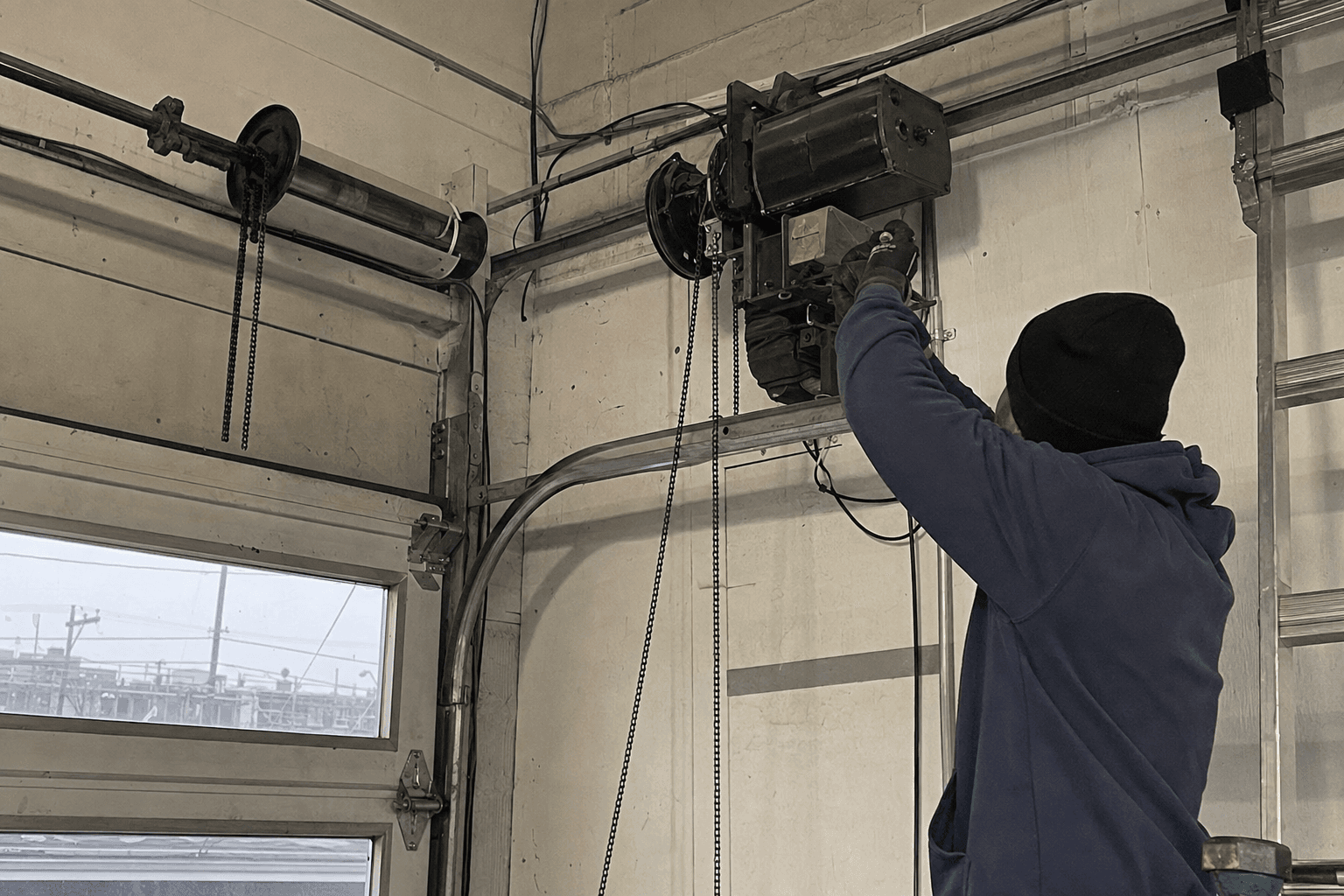
A commercial door operator overheats when the motor works harder than it was sized for. The usual causes are an undersized operator, a door that is out of balance or dragging, too many cycles, or safety devices that keep reversing the door. Check how the door moves and how often it runs. Fix the cause, because resetting the motor only delays the next shutdown.
What overheating looks like on a commercial door
Most operators have a thermal overload. When the motor gets too hot, it shuts itself off to protect the windings. You press the button and nothing happens. Twenty minutes later the door works again.
That pattern is the main sign. Other signs include a motor housing too hot to keep your hand on, a burning smell, and a door that slows down late in the day.
We see this on doors that get heavy use. Storefronts and retail plazas in Sapperton and Uptown, auto service bays, and strata parkades in Downtown New Westminster all put a lot of cycles on a motor.
Why the motor gets too hot
Heat comes from work. The motor makes heat whenever it lifts weight, fights friction or starts and stops. Anything that adds load or adds cycles adds heat.
These are the common causes.
- An undersized operator. The motor was too small for the door, or the door was changed later and the operator was not.
- A door that is out of balance. If the springs have weakened, the motor lifts the door's weight instead of just guiding it.
- Binding or dragging. Bent track, dry rollers, worn hinges or a door slightly off track all add friction.
- Too many cycles. A door opened for every car or customer may run far more than the operator was built for.
- Safety devices that keep reversing the door. Misaligned photo eyes or a worn safety edge make the door open and close again and again.
- A tired motor. Worn parts and weak start components make a motor run hotter than it should.
- Old operators. An older unit may have no parts available, so the repair options are limited.
Why balance matters more than most people expect
A correctly balanced door feels light. The springs carry most of the weight. The operator only moves it.
When springs lose tension, the operator picks up the slack. It will often keep working for a while, which hides the problem. Then it overheats.
Springs on older doors fail more often in the first cold snaps of the season. A spring that is close to the end of its life is already weak before it breaks. If the operator started running hot this fall, the springs are worth checking.
Springs and cables are under high tension. Don't adjust them. That job is for a technician.
Damp weather and sloping sites
New Westminster is mild and wet. Damp weather wears wood doors and frames. A wood panel that has swelled or a frame that has moved can add drag you cannot see from the button.
Many lots here slope toward the Fraser River and are partly shaded, so surfaces stay damp longer. Queensborough sits low beside the river, and moisture and grit get into tracks and rollers there as well. Tight lane access in the older parts of town can also mean vehicles stop and wait with the door open and closed repeatedly, which adds cycles.
What you can check safely
You can learn a lot without touching anything under tension. If you are not sure it is safe, skip a step.
- Note when it stops. Is it after a certain number of cycles, or only late in the day? Write it down.
- Watch the door run. Look for jerking, slowing, a tilt to one side, or rubbing at the guides.
- Check the photo eyes. Look for a lens that is dirty, knocked or pointing slightly off. Wipe it and see if the door still reverses.
- Look at the safety edge. A cracked or crushed edge can signal contact when nothing is there.
- Feel the motor housing. Only after it has been running, and only briefly. If it is very hot, note that.
- Try the door by hand. Disconnect the operator using its manual release, then lift the door. It should move smoothly and stay put near the middle. If it is heavy, drops, or binds, the operator is not the real problem.
Do not keep resetting the operator and pushing the door to work. Each overload shortens the life of the motor.
Repair or replace
The fix depends on the cause.
If the door is out of balance or dragging, we correct that first. Often the operator is fine once the load is right.
If the safety devices are causing extra cycles, we realign or replace the photo eyes or safety edge. That also fixes the reversing.
If the operator is undersized for the door or the traffic, a larger or different type is the better choice. Trolley, jackshaft and hoist operators suit different doors and different headroom. A properly sized operator with working safety devices keeps a busy door reliable.
If the operator is old and parts are no longer available, replacement usually makes more sense than keeping it going.
Most repairs take a few hours. A new operator takes about a day. In a strata building, we plan the work around residents and tenants. For a business, we plan it around opening hours so the door is out of use for as little time as possible.
When to call a professional
Call when the operator has overheated more than once, when the door feels heavy or uneven by hand, or when a safety device keeps reversing it. Call before the door fails fully, especially on a parkade or a service bay where a stuck door affects residents or customers. If you are a property manager or strata council member, a technician can also tell you whether the operator is sized for how the door is really used.